Some of my favorite cars ever made
were “one offs,” cars that either were taken off the assembly line and
redesigned to such a uniqueness that not another one was ever built or a car
that was built from the ground up and an additional one was never made. Prototypes
usually go through this but most of these kinds of cars are usually scrapped or
if that unique, are placed in a museum. One-offs and prototypes both share a
commonality in that even though not that many exist, they are usually
trailblazers either in design cues for what the manufacturers have in store for
us in the future if not for their historical contribution. One such car of
significance was not just the 1961 Lincoln Continental, but the 1961 Lincoln
Continental Presidential Parade Car dubbed as the “SS 100-X.” This was the car
that was commissioned into US Secret Service duty during John F. Kennedy’s
Administration as the president’s state car, and upon its debut as it became
known as “the Kennedy Lincoln.” Unfortunately it also gained notorious fame as
the car in which President Kennedy was murdered two years later in 1963.
 |
| At the North Portico of the White House, March 1961 as the USSS introduce to the White House Press Corps President Kennedy's new limousine, the 1961 Lincoln Continental Presidential Parade Car, dubbed by the USSS as the "SS 100-X." As much as I know about this car I never could find out why it was called the "100-X." |
 |
| The 100-X standing by on the north side of the White House in one of its different bubble top glass configurations, as it had more than one type of roof before the assassination. |
Just before Robert McNamara walked
out the door as Ford’s CEO to become President-elect Kennedy’s Secretary of
Defense, and just before Elwood Engel also left as design chief at Ford before
heading to Chrysler, both in 1961, McNamara put Engel in charge of designing a
car that would turn Ford’s fortunes around after successive years of failure.
The Ford Edsel project of 1958 proved to be a disaster, and the late 1950’s Lincolns
and Continentals were proving not to be the hotcakes compared to what Cadillac
was spinning out just before Harley Earl was winding down his career as design
chief over at GM. Looking back at automotive history, do you ever remember a
1959 Lincoln catching anyone’s eye as opposed to a 1959 Cadillac Fleetwood,
fins and all? That was the problem facing Ford, and they needed a car that was
going to be a trailblazer and a hot seller, so they gambled their money on
Engel’s eventual iconic award winning design that initially had its sights on becoming a Ford Thunderbird. But
by 1961 the Ford Division felt that the Thunderbird was becoming too big as it
already was as it originally was supposed to compete with the Chevrolet
Corvette, which by then Ford had given up as the ‘Vette competitor as the Chevy had already surpassed the
T-bird to its own iconic status. The new Thunderbird was becoming a “personal sized
luxury car,” but Engel’s design with an additional two doors was perhaps a bit too
much, so the Ford Division rejected Engel’s flat angular squared-off design as a new Thunderbird. McNamara,
the utilitarian he was whether it was about rockets, jets, tanks, or cars (one
product for many divisions or service branches), wasn’t having it, so after
spending all that money on product development he announced at an executive
committee meeting just before he left Ford that somebody was going to
manufacture and sell the car no matter what. Lincoln was left holding the bag,
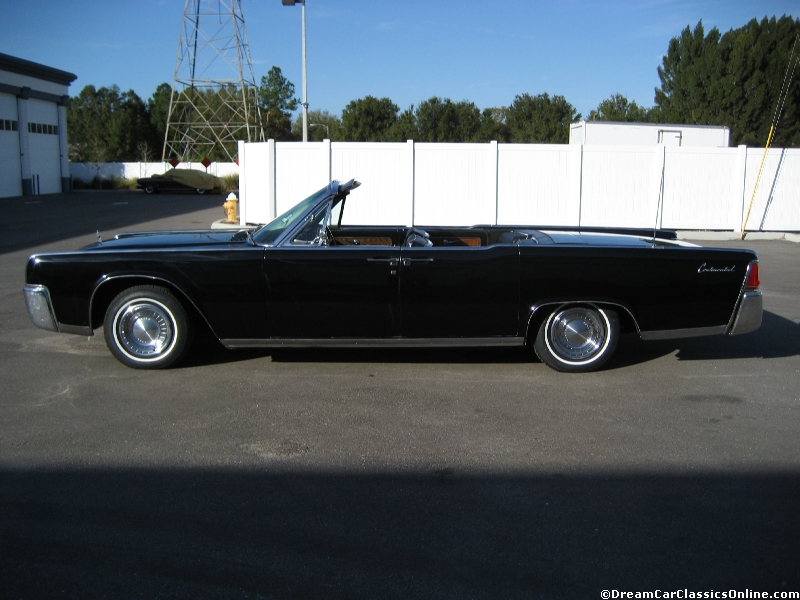
and the iconic 1961 Lincoln Continental was born. As a good measure just before
he walked out the door at Ford to head for Washington, he called the Wixom
assembly plant in Michigan to have a ’61 drop top unit pulled off the assembly
line after completion and shipped to Ohio to be cut up, coached, and used as
President Kennedy’s new state car. This is where the SS 100-X was born.
 |
| A stock 1961 Lincoln Continental. |
 |
| The 100-X in its early days of service in one of its bubble top configurations. |
 |
| The 100-X in its steel top confuration. None of these tops were bullet proof before the assassination. In fact they were done away with as per Warren Comission guidelines in lieu of a permanent hardened ballistic steel roof with the largest bullet proof glass panel currently in its present configuration at the Ford Museum. (See further below). |
From taking a $7400 top of the
line Lincoln convertible, Ford and the Secret Service shipped the car to
Cincinnati Ohio to the coaching house of Hess and Eisenhardt who once
specialized in creating and modifying automobiles into security vehicles to
have the car heavily modified for presidential use, though initially the car
wasn’t “hardened” or modified for ballistic protection. The $200,000 car was lengthened
two feet longer, further reinforced to prevent convertible undercarriage body
flex, and had a myriad of additional grab-handles and steps added for Secret
Service agents to use while riding alongside the car. A hand assembled 430 cu. in. 350 horsepower V-8 engine was added. The most unique feature
of the car was its assortment of different glass and stainless steel removable
tops, all not bullet-proof, but that could be used in all sorts of processions
and motorcades under varying weather conditions. The car was given a front
grille refresh in 1962. One of the flaws of the design was that since the
car was so large and long with all that glass overhead, the car would become a
greenhouse in the sun or warm weather with its wimpy stock air-conditioning
unit that only blew in the front of the car, suffocating passengers in the
back, especially when the glass partition was up for private conversations.
President Kennedy and his passengers would often complain about this problem
for him to frequently insist when traveling to have the top down, as he did on
that warm sunny day on November 22, 1963 in Dallas.


But as the Kennedy Administration
chugged along though the early 60’s the SS 100-X became closely associated as
Kennedy’s car. It went with him just about everywhere around the world, even to
the Berlin Wall where he gave his famous “Ich Bin Ein Berliner” speech. The car
was also loaded onto to a transport plane in late November 1963
for his political fence mending trip to meet Texas Democratic Party leaders
with him and Vice President LBJ in Dallas and Forth Worth. One of the special features of the
car that probably assisted the gunman in killing Kennedy was a hydraulic lift
that was fitted into the rear seat of the car that when lifted made the back
seat more visible as the car drove by. This combined with the back brace the
president wore for his ailing back that gave him a stout posture, made him an
easier target for a sniper.

You would think after President
Kennedy’s assassination that a blood, brain, and skull-splattered car would be
cleaned up, decommissioned, retired, and placed into a museum as an exhibit for
the ages. That’s what they did to President Lincoln’s bedroom at Petersen House across the street from
Ford’s Theater after he was assassinated at it is now enshrined forever. For some reason, Warren Commission and all,
only the bullet riddled windshield of the 100-X made it to the National Archives and the car was unbelievably sent back
to Hess and Eisenhardt for what was called “the Quick Fix.” The car was rebuilt from the ground up and
finally given titanium ballistic armored plating. This would be the last car a
President of the United States would ever ride with an open roof, as using a
state car like the old “Lincoln Sunshine Special” from the Roosevelt Days was
finally over. They affixed what was at the time the largest piece of
bulletproof glass anywhere in the world into a new steel roof that was
permanently attached and hardened against attack. The gas tank was hardened to prevent puncture or explosion. The first run flat tires were
added to a presidential car, probably any car anywhere in the world, as the rims were replaced with aluminum to keep the
car running in case of a code black (attack on the motorcade) or code red
(attack on the president). The president could now never roll down a window to talk
to someone to instead use a PA system installed in the car to speak to the
crowd with a microphone. Many new features that were added to the "Quick Fix" were progenitors to what is currently on President Obama's state car, a 2009 GMC Topkick heavy duty truck that has been specially modified to look like a 2009 Cadillac sedan, another "one-off" special security vehicle that is another one of my favorites.
 |
| At GM's Hamtramck Plant in Michigan, their special vehicles division is able to convert a 2009 GMC Topkick Heavy Duty Truck (above) and make something special like the next two pictures below, a heavily armored car that looks like a late model Cadillac sedan. GM in fact makes no such car for production like President Obama's limousine, although it does look like a Cadillac. |
 |
| Thanks to the 100-X many of its security features were inherited into President Obama's limousine, the 2009 Cadillac Presidential State Car, which is actually a heavy duty truck modified to look like a Cadillac. If you carefully look at the size of the tires compared to the Secret Service Agents, you can see that this is a huge car. |

LBJ never liked the stock midnight blue the car came
with from Wixom, it reminded him too much of JFK's identity to the car and was afraid the car would
be dubbed “the JFK Assassination Car,” which is exactly what happened by the press when the
car was returned to the White House Garage for service in early 1964. He
ordered the car back to Hess and Eisenhardt to have it repainted Earl Scheib
style (sans the door jams, trunk and hood wells) the standard funeral black,
which remained the official presidential state car color ever since. The car
was finally fully repainted after every presidential turn over of
administrations to cover dents and dings until the car was decommissioned from Presidential
service during the Carter Administration in 1977. Most importantly, the
“Quick-Fix” also included a separate air-conditioning unit that was added in
the trunk that would cool the back seat passengers. Too little, too late, but timing
is everything. How prolific that Presidents Johnson, Nixon, Ford, and Carter
sat in the same car and seat that
President Kennedy did when he was murdered, whether they realized it or not.
 |
| The SS 100-X on permanent display at the Henry Ford Museum in Dearborn, MI. The bullet proof glass panel over the rear passengers' heads and slopes down behind the back seat where the president would normally sit seen here (above) was once the largest piece in the world. It was also the heaviest at almost 1000 lbs. |
 |
| If you notice in the above picture the rusted paint on the door in front of the side view mirror is the Wixom midnight blue that was the original color of the car that was never painted over. There is a growing chorus of history buffs that are calling for the car to be restored back to its original livery of 1961 when the car first entered service during the Kennedy Administration, just as the car looked when JFK was assassinated while sitting in this car. |
 |
| Notice that after several years of a grille refresh the car stayed in its permanent livery of having a 1962 grille until its retirement in 1977. The Lincoln star crucifix on the hood was also removed as well, probably either as a precaution or from its many re-paintings. |
After 50,000 ground and one
million air miles of presidential service, the car remains for the ages on exhibit at the Henry Ford
Museum in Dearborn as an iconic piece of history not just for its occupants,
most notoriously its first one, but also as a showcase representative of what
would become the quintessential styling cue of the Lincoln Continental brand, from the
angular gait of the body and crucifix star hood ornament, to the spare tire on the outside of the trunk to the suicide doors, and all. As 2011 celebrated the 50th anniversary of the commissioning of the 100-X, this year in 2013 will somberly commemorate the 50th anniversary of President Kennedy's assassination while he was riding inside the 100-X. Besides the fact that the 100-X is a security vehicle which I identify with in my line of work in the security business, the Lincoln
Continental convertible is one of my favorite cars and the SS 100-X is the best
example of that genre of automobiles. As the commercials used to say, Cadillac
might be “the standard for the world,” but a Lincoln is “what a luxury car
should be,” especially when it comes to a "Kennedy Lincoln."
 |
| The "X" on the ground is the exact spot that was the JFK fatal head shot as he was driving by in Dealey Plaza in Dallas, Texas, November 22, 1963. One of the tours around Dealey Plaza features a replica of the SS 100-X that you see here that tourists can ride in to recreate the event. |
--> EDITORS NOTE: In a previous version of this story I incorrectly stated there were two front grille refreshes done to the car when in fact there was only one. This wouldn't preclude any replacement grilles done when the car was repainted many times. When President Kennedy was assassinated in 1963 there was a 1962 grille on the car. The present front grille on the car as displayed in the Ford Museum has a 1962 grille. Please pardon the confusion. Thank you to the Lincoln aficionados out there who caught the tech faux pax; you really know your Lincolns. -AC 9/22/2014
Suggested
Reading:
What is a CARMAGEDDON and when will
it happen?
Am I allowed to walk on a highway?
Suggested Reading:
The
definition of a “Concours” car and event
Suggested Reading:
Suggested Reading:
What is the new national terror alert warning?